You might be wondering why I didn’t let you be as good and perfect and noble as I know you truly wanted to be. Why?–you might ask–did I not protect you from those moral dilemmas that you’re still not sure you dealt with the way you should have. Why didn’t I remove the obstacles to your purity and kindness? Why did you have to get your hands dirty and find out that you’re more of a hypocrite than you ever thought you would be? Why did you have to find out that you too (not just your enemies) had prejudices and hatreds and bitterness?
Well, I have to admit, it’s because I love you. And I wanted you to live, even though I knew it would lead to this painful result. When I shielded you from complex situations, from mixed motives, from selfishness, from ruthlessness–from lies of omission–you were dead on the page. Less even than a puppet, you were as flat and bland as cardboard. I could scarcely see you, you were so unreal. You had the dry dust taste of something that cannot really nourish, cannot satisfy, cannot strengthen.
It isn’t that I wanted you to make mistakes. It isn’t that I wanted your heart to harden, till you turned back and looked, aghast, at what you have become, at how you’ve treated those you claim to love. I want you to do right and be righteous too, believe it or not. But I had to provide opportunities for failure, otherwise it would all have been a sham, a fake. Empty, empty, empty. And once I provided those opportunities for failure, guess what? Sometimes, you failed.
Look, it was inevitable. Being pretty emphatically not perfect myself, I just don’t know what perfect looks like. So if I tried to portray it, it would never work. I can only give you my own flaws and my own same wish that I did not have those flaws.
“For what I want to do, I do not do, but what I hate, I do…what a wretched man I am!”
Obviously you’ve never heard those words, being fictional and in a fantasy world, but think you understand them in your bones. Anyone who is even the least bit alive and the least bit honest probably does.
I think authors usually imagine that their characters would complain about all the turmoil we put them through. But I don’t think that is your complaint. You are the sort of person that accepts that hardship is part of life. You assume it. So I won’t address that. For your turmoil, I have my reasons.
But here is the answer to the question that really plagues you. Not why didn’t I protect you from hardship, but why didn’t I protect you from the darkness within yourself.
Well now you know. I had to shed light on it lest you be a shell of a person. If I have to face the brutal facts about my own soul, so do you.
Love,
The author
If you like a character with strong convictions, fierce beliefs, and a deep desire to do what is right, but whose hands don’t always stay clean, and who doesn’t always live up to their own ideals, you might like the main character of my book: Azetla. He’s a pariah, a debt-soldier, a leader (so long as it’s not on the record), a lefty, and figures that ‘the only way out, is through.’
I did not realize till yesterday that I had let a whole month go by since writing a blog post. Not that these are strictly necessary–they are a mixture of casual joy and helpful discipline–and certainly no one has been knocking at my door, demanding I explain why I haven’t written one in a while. This blog is a bit like a quiet corner in a out of the way coffee-shop. Good conversation. Low population. Sometimes contented silence.
I just like to be consistent, is all.
But I have been busy. I don’t particularly like to be busy. I like to have lots of time to go on long walks, or have long ‘thinks.’ But I have five children, I homeschool, I teach Jiu Jitsu, I compete in Jiu Jitsu, I help facilitate a bible study at chapel, I’m re-writing (not merely revising) book 3, and the pile of unfolded laundry sometimes nearly reaches the rafters of the roof (we do not have rafters, but it was about as tall as my 9 year old a couple of days ago).
Regarding my Books
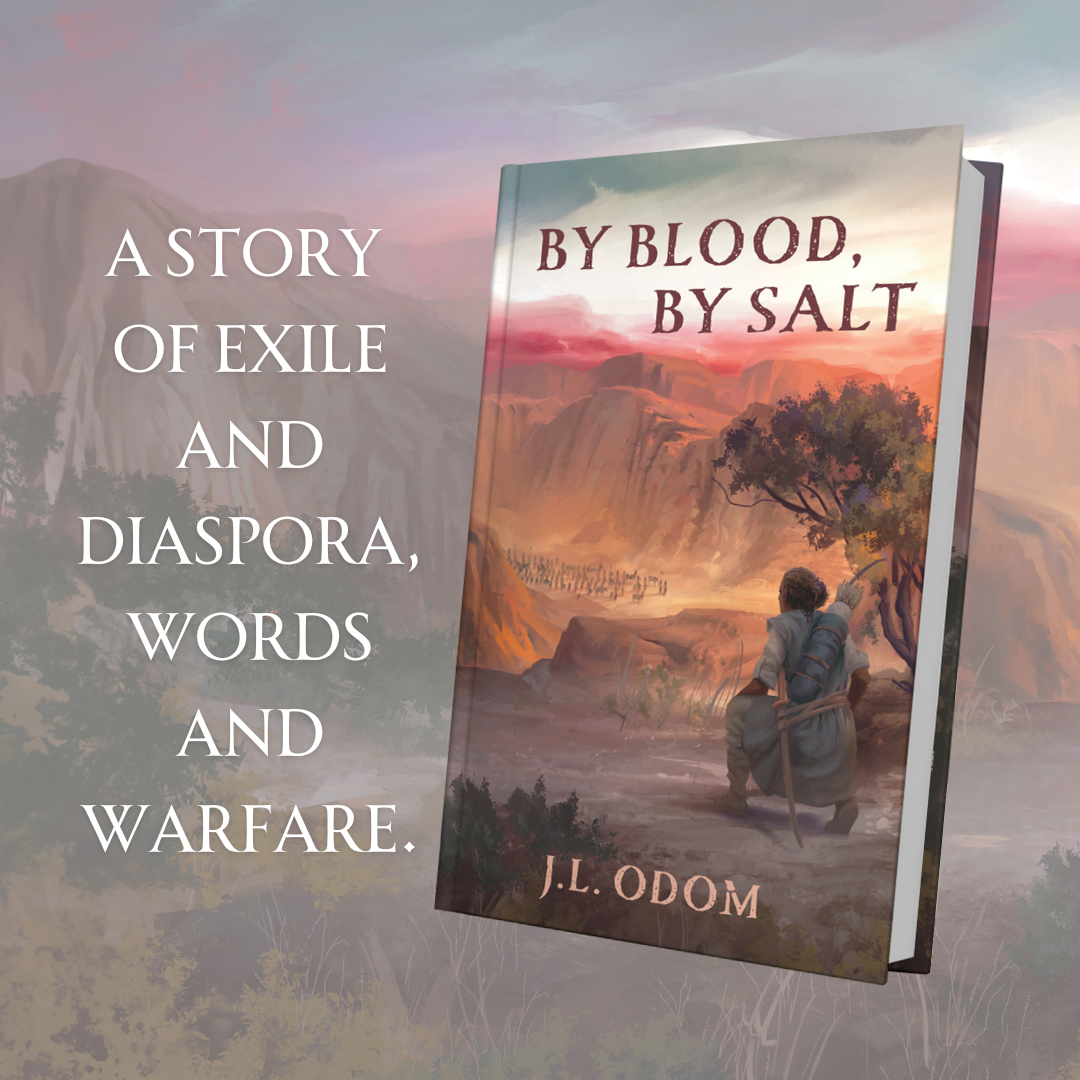
A thorny topic. Book one of my Land of Exile trilogy, “By Blood, By Salt“, has been out in the world for nearly four months. I have learned that at the early stages of self-publishing, especially when one only has a single book in the atmosphere, one must hustle for every single sale. And I am not particularly good at hustling. I imagine not many writers are.
I ran a labor day sale with a book promo (a thing I did not know how to do only a week prior) and made more sales in those four days than I had in the entire month prior. Thrilling, yes, but then reality hits and when the sale is over, it’s back to the aforementioned hustle.
It’s hard to love something so much and know it has no guarantee of success. But that’s how things go.
Book 2 is with the line editor. Good chance I get it back in the next couple weeks. I’ll read through, then send it back for proofread.
Art work for the cover will begin end of the month.
Book 3 is a 35K words. I am very excited about it and very nervous because I can really *see* everything better and better, but seeing it is not the same as writing it, and the work is slow.
I am still in the SPFBOX competition, however this only by default. No one has either been reviewed or cut from my group as of yet. However nearly half of the other books have been cut, some gently, some rather brutally. There are twenty-some semi-finalists and one finalist.
I love my book. I have been thrilled to discover that others do too. I hope it strikes a chord with the judge as well.
Regarding other Books
I just finished “The Once and Future King.” I had very mixed feelings. They are chronicled in goodreads.
I just started “Silence” by Shusaku Endo
I am nearly done with “Mama Bear Apologetics” which I read for the Bible study I’m leading at chapel. It’s decent. I have some critiques. I think it tries to cover too much too fast and needed to slow down and savor concepts over topics.
I am also almost done with :Knowing God” by J.I. Packer. Very sound theologically, and valuable. But, being accustomed to Lewis’ eloquence and Chesterton’s wit and whimsy, it feels staid and plodding by comparison.
Kids and School
I have a 5th grader, a 3rd grader, a 1st grader and two Pre-ks. It’s a good thing they are all so darn smart and just seem to figure things out so quickly and easily, because I’m not sure what I’d do if I hit a real roadblock, as I know most parents eventually do. I’ve had it pretty easy so far, and school is going (relatively) smoothly.
Jiu Jitsu
I did my first competition at purple belt! I lost! But that’s okay! Truthfully, I really enjoyed going, and now the worst is over. Purple belt is a tough one because people often spend 2-4 years at purple belt, and it really does transition you from beginner to advanced. I’ll likely compete again in December, and I’ll get to gauge my improvement.
I have a few new students in my Ladies’ class, which is a joy, because attendance had been sparse there for a while.
Growing in Jiu Jitsu is so often just about showing up.
Well, well, well. If it isn’t the trope I’ve been avoiding like the plague. Not because I hate it, mind you, but because I hate that our collective obsession with it causes many of us to accept some very dumb plots/events/behaviors that we would never otherwise tolerate. Contrary to popular opinion, a sexy knife to the throat does NOT actually cover a multitude of sins! Broodiness is not depth! True enmity is not so easily resolved!
But I’m getting ahead of myself. Best stick to the formula.
What is Enemies-to-Lovers, other than the obvious? Let’s tackle this behemoth.
Please, Define Your Terms
Enemies-to-Lovers: Two characters, opposed to one another, in a deeply antagonistic relationship–opposite sides of the conflict of your choosing–slowly develop feelings for one another. Anger! Angst! Woe! Drama!
Danger, probably. Banter, almost certainly.
Some point to Pride and Prejudice as a classic origin of this trope. It is valid enough. He holds her family in contempt, and she hates him for his arrogant and offensive behavior. She believes every malicious word she hears about him. He actively tries to stop his friend from marrying her sister, devastating her hopes.
Or Merlin and Nimue? He falls in love with her but she traps him in a cave for centuries. Perhaps?
Samson and Delilah? That doesn’t end well. Regina Spektor thought it was an opportunity for romantic exploration, and penned a tender, aching what-if about it (a gorgeous song) but brass tacks reality is as follows: Delilah is relentlessly malicious and Samson is shockingly stupid. Not a great start for the trope.
We must quickly differentiate this from star-crossed lovers (I did that trope here). Star-crossed lovers are not at odds with each other. They love each other. It is outside circumstances that keep them apart, not some personal enmity.
So. Knives-to-throats, be they literal or metaphorical, and yet they fall in love. Got it.
Without any further ado, on to our questions 3:
When does it fail?
When does it work?
And why does it resonate?
No. Wait. You know what? We’re doing it in a differently this time. Because the truth is, the “succeed-or-fail” of this trope is by far the most obvious and least interesting thing about it.
The answer to those first questions can all be summarized in a few sentences. It’s a bad job when they were never really enemies to begin with. It’s obnoxious when the obstacles they have to overcome are fake, conjured out of thin air and likewise evaporated into thin air. It’s exasperating when it’s insta-love or insta-lust. When the plot behind the romance is paper-thin. When it costs nothing. So on and so forth.
But we know all this already. As with all tropes: deep characterization, good writing, and honesty will do the trick. The author must use restraint, and not get over-excited and jump the gun with the swoony bits. The flaws and conflict must have meat. We get it.
But how often do you see this trope done WELL? Not very often. How often do you see the same dull cliches played out? All the time. “Oh my goodness he’s my enemy, but he’s so haaaaandsome!” “I’m supposed to assassinate you but I. Just. Can’t!”
I roll my eyes. I shake my head. I tisk my tongue. I want to wash my hands of this nonsense.
And Yet…I confess, I still want to see it. In spite of this.
The trope is astonishingly resilient, isn’t it? Surviving the most atrocious usage. Indeed, “Eros, turned upside down, blackened, distorted, and filthy, still bore the traces of his divinity.” The trope will be savaged by a stupid story and terrible writing and people will say “you know what? I don’t care, give it to me anyway.” Snag one smoldering screenshot from an arguably terrible Star Wars movie and you birth a million Reylo fans. [Rey and Kylo fans]
Why is that?
Why do we like this trope so much? WHY?
I am not the first person to try to analyze why this trope makes so many people jump and leap and swoon, go all googly-eyed and lose their common sense.
Let’s start with the surface-level explanations and work our way to matters of cosmic significance. Yes. Cosmic. Something doesn’t get its hooks in you like this unless it has to do with life and death and eternity.
Reality Reversal
I think Elizabeth Wheatley cuts small chunk out of the question HERE. She essentially claims that part of the draw of a “bad boy” or “enemy” love is that they have already shown you their worst, and it turns out they are better than you thought, and they grow in your estimation as opposed to a man who shows you his best at first, and steadily deteriorates from there, turning out to be horrible.
I think that’s a valid point and a pretty good place to start. A beginner’s slope, if you will, for enemies-to-lovers. Pride and Prejudice is an excellent template for this notion. Darcy starts out like a jerk, but turns out to be really honorable. Wickham seems fun and friendly, and turns out to be a dastardly fellow and a predator.
But this barely scratches the surfaces of the appeal of this trope, dealing with it in only its mildest and most pragmatic form. I think there is something far deeper going on here. The appeal seems to be about so much more than a reversal, and more about the high and grand drama of it. The danger of it. The dire threat of it.
A Certain Flavor of Tension
Most romance necessitates tension. Even if it a sweet, shy, nobody’s-about-to-die romance, there is usually at least a little tension. Some uncertainty. Some quiet hopes and fears. Some moments of almost before the moment of culmination.
Enemies-to-lovers cranks the tension up past 11, by piling question on top of question. Not only is it “Do I love him? Does he love me?” but “Do I kill him? Will he kill me?” “What will be sacrificed? The lover or the objective?”
[Note to self and to reader: Why, pray tell, am I saying “I” all of a sudden? Why am I inserting myself into the narrative. INTERESTING. Don’t worry. We’ll get to that. It’s all part of the desperate gut-level appeal of this trope.]
The tension is the fun part for most people. So why not add as much as possible?
I definitely thinks this is another facet of the appeal, but I also think we have not yet got to the core of it. You can get tension anywhere. You can grab tension in bulk at Costco by adding a war or a wound or a second love interest. Get some fine boutique tension by making it a second-chance romance, or some heavy-duty Home Depot tension by hiding a mad wife in the attic or a severe class disparity, you know what I mean?
So that can’t be the whole answer. It just can’t be.
Love is Stronger than Death
Now we’re getting closer to the beating heart of this trope. Something more along the lines of Love Conquers All. It conquers even the souls of enemies. But why should we want to conquer the soul of our enemy? Or for our enemy to conquer our soul? What is the meaning of that?
This is where we must talk about the self-insertion aspect. This trope, arguably more than any other romantic trope, seems to lend itself to self-insertion. WE WANT TO EXPERIENCE THIS. The readers imagine themselves into this situation where we are a captive prisoner, or a rebel soldier, and the enemy first shows us ferocity…and then, shockingly, mercy. Then, still more shocking, desire. Longing. The enemy is zealous for me? Me??
If the conflict and enmity was REAL and well-written, this will be a gorgeous moment for the reader. Love has consumed hatred. Obliterated it. Scrambled over it with bloody hands. Wrought the grief and harm of it into something beautiful that pierces the soul. We (for, lo, we have inserted ourselves by now, haven’t we?) we are worth the overturning of the earth. We are worth sacrifice and loss and yearning.
But are we really worth it? What if…we’re not?
You reach this point in the story sometimes. He sacrifices his kingdom for the enemy he loves. Who would do that? Very impractical. Give up everything? Really? For her?
The Cosmic War
This is why we must acknowledge the psychology of wanting a seemingly harsh enemy to turn into a good lover…then keep walking.
Acknowledge the visceral desire for tension. And keep walking.
Acknowledge the desperate longing for personal worth, for love-conquers-all, and still keep walking. For by then we have nearly crested the final hill.
We want to see that someone, while they were still an enemy–before they were good, before they deserved it–was loved. In spite of themselves.And in spite of circumstances that made such love seem impossible and irrational.
It wasn’t Samson and Delilah we should have been looking at. It was Hosea. A man who married a prostitute for the sole purpose of modeling the original enemies-to-lovers as it stands on a cosmic scale.
A God who chose a people, not because they were great, but because they weren’t.
A great sacrifice made not because the lover deserved it, but because they didn’t and never could.
In the stories, these are the best ones: While she is still his enemy, still against him, would still kill him, he would give his life for her.
So then…we are the enemy. And He is the lover. And there is nothing we want more in all the world than to be loved like that.
That is why we love that Darcy moved heaven and earth for Lizzie even after she’d utterly rejected him.
It was why, despite the tremendous weakness of the movies, people still were moved by Kylo Ren in the sequel trilogy, if nothing else. “You are no one. Nothing…but not to me.”
If you are not religious, this conclusion might not please or satisfy you. You just wanted to explore the tantalizing elements of a trope you love, not have someone tell you “It’s about God, actually.” But…it is about God actually. Everything is, whether for or against or at an oblique angle. It’s about the fate of the soul. Whether you merely believe in “The universe” or in nothing at all, this question and longing will still arise in the soul and haunt it. If the enemies-to-lovers trope is all it can find, it will hunt it out and eat it a thousand times, well or poorly made, hoping, yearning to be sated by something otherwise ineffable.
Take it from dear John Donne, who found his way from writing erotic poems about women to writing romantic poems about God.
“Batter my heart, three-person’d God, for you
As yet but knock, breathe, shine, and seek to mend;
That I may rise and stand, o’erthrow me, and bend
Your force to break, blow, burn, and make me new.
I, like an usurp’d town to another due,
Labor to admit you, but oh, to no end;
Reason, your viceroy in me, me should defend,
But is captiv’d, and proves weak or untrue.
Yet dearly I love you, and would be lov’d fain,
But am betroth’d unto your enemy;
Divorce me, untie or break that knot again,
Take me to you, imprison me, for I,
Except you enthrall me, never shall be free,
Nor ever chaste, except you ravish me.”
[If you want more trope deep-dives, here is the trope master list]
Book one is still out there! In the world! For just over 2 months. So far so good, though with self-publishing, it’s slow and steady for the win. Patience is a virtue. I think marketing helps too…
I am up to 10 ratings on Amazon and 28 on goodreads. Might seem like small potatoes to some, but I’m very thankful, especially for the “wild” reviews, AKA reviews from people I do not know, am not related to, and did not ask to ARC read!
THE BIGGEST NEWS: I am, as of this very minute, beginning the process of getting an audiobook made. I am supremely lucky in my circumstance, as I will be working with someone I can meet up with and collaborate with regularly in person. Kind of unheard of. Pretty amazing. Nervous and excited all over.
I still love this book. I hope you do too.
Book 2 Updates
I got revision notes from my dear friend and Alpha/Beta reader extraordinaire, and did the revision according to her feedback. I sent it back to her and she’s going to give another hard, critical look, targeting specific changes/questions/concerns. When I get it back, I’ll do a final revision and try to trim and nice clean 10k off the word count (currently 155K).
Once it’s spit-shined (hopefully by the end of August), I will send it to the editor for a line edit then a proofread. Hope to have the final-final end of September/early October
I am prepping the art pitch for my cover artist, which I hope to send out next month!
If all goes to plan, this will result in a publication date no earlier than December and no later than February.
AND If all goes well with the audiobook for book 1, we will roll right into book 2, and the audiobook for book 2 will be able to release at or around the SAME TIME as book 2. That’s wild.
Book 3 Updates:
Let me check…Okay, I’m at 28,000 words on the new draft of book 3. I still refer to the old draft, but only for guidance. This is being written more-or-less from scratch. So much has changed.
I am smack-dab in writing one of my favorite scenes. I am enjoying it thoroughly, but each sentence requires meticulous crafting. Gotta get it right. A scalpel is required to perfectly cut every phrase, every emotion, every reaction.
I think it would be foolhardy to make projections. I am slow, and life is full. But if I can maintain a moderate, steady pace, the draft could be done by May 2025…
Which is good, because I have plenty of time to think of cover art for book 3 as I haven’t visualized it at all yet.
Meanwhile I had my birthday last week and got a gift card and ordered some books. I am very excited about that too!
Just in case you didn’t know (you did know) you can get my book on: Amazon and Barnes and Noble and you can add it on goodreads
ALSO, if you wanted a hardcover and then you went to Amazon and you were like “why so expensive Amazon? Why upcharged AMAZON??” Then you can just buy the hardcover directly from the distributor (Ingramspark) and we have set the price so that it is off-set for shipping. So don’t be overcharged. Don’t do that.
And in case you wanted a paperback with slightly nicer color and binding than the ‘zon one, same deal, paperback priced to offset the cost of shipping so it’s as if you got prime shipping and all that. Paperback link.
These are some of the most prominent tools people are using these days to discover (or pitch) their next book, because it’s a fast-fashion, low-attention world out there. I find them, for the most part, useless and exasperating. But not always. This isn’t meant to be a hoity-toity snobbish thing where I deride “the youths” and “the culture” but rather an examination of why I, personally, have found certain of these techniques to be hollow and genuinely unhelpful. The more heavily they are used and relied upon to pitch a book, the less likely I will ever pick it up.
I fully understand WHY these methods are used. The platforms demand it. If you only have a few second, or a few lines, to get something across, it’s gotta be punchy and well-distilled. This is not, in and of itself, inherently wrong. There is a pragmatism to it. “Hooks” exist for a reason. But in the end, it’s utterly pointless to me. It doesn’t crack the geode. It doesn’t tell me what’s really inside. It honestly doesn’t tell me anything. Because it can’t.
Aesthetics
A series of images flash before your eyes to the strains of an evocative violin. For approximate 20-30 seconds, you are inundated with either the gothic, or the mythic, or the epic, or the tragic, each vision coming and leaving the screen before you can even fully grasp what you’re seeing. It’s meant to attract your eye, to tell you “this is what this story will look and feel like.” But only if you enter will you get the full picture.
For marketing purposes, I think this one can be very effective. At first. If someone can put together a beautiful aesthetic for a book, full of evocative imagery, hinting at drama or romance or dread or darkness or whatever it is the book supposedly possesses, they eye is drawn. You see a dozen of these babies pop up on your social media feed and you begin to believe that maybe, just maybe, this book really has something to offer.
So maybe you buy it on aesthetic alone. And one in a hundred times maybe the “aesthetic” really told the truth, and the book really does evoke all those emotions/images. Maybe. But after a while, they will all begin to look the same because it is an effort to capture a whole in a very, very small part. Inevitably it becomes repetitive. Flashes of a beautiful woman, a handsome warrior, dragons, fires, swirling colors, grand castles–it all begins to bleed and blur together till it nearly loses its power to pierce the heart.
Because here’s the thing. If I read a book and I am PASSIONATE about it, I feel all that passion when I communicate my love for that book to someone else. But I can’t necessarily make you feel what I feel, no matter how many cool-looking images I use. The book has to be experienced.
Is the book more than flashy imagery? Is there meat and marrow there? Do the characters have depth and complexity? Will I forget I read it the moment I put it down because it was all nothing more than an aesthetic to begin with? Yes, a beautiful image can draw the eye. Indeed, it should. I grant this. But there must be something more to draw the soul. And if I have been fooled by images too many times before, I will numb myself to them so as not to be fooled into reading drivel again.
I will say that pitching a book by aesthetic is going to be more effective when done by a READER than when done by an AUTHOR. If a READER feels passionate enough about a book to get creative in trying to convince their friends to read it, that is far more tempting. If an AUTHOR does it, all they are saying is “I hope you feel these things. This is what I want you to experience. These are the images that inspire me.” But that says nothing about whether or not they succeeded.
Vibes
Since this one is nearly impossible to define, you would think it the most difficult to communicate. But that’s not really so. What are “vibes”? Typically this means “the feel of.” It has Lord of the Rings “vibes”–aka it feels like classical high epic fantasy, with clearly defined heroes and goals. It has Dune “vibes”–aka Sci-fantasy with complex politics and deep lore. It has Jane Eyre “vibes”–gothic, pensive and romantic.
This one might, for all its seeming vagueness, be the most helpful of the lot. Sure, it requires that you have familiarity with other works whose “vibes” it ostensibly shares, but I’m going to give this one a pass.
It may sound silly, and I may get irritated hearing people say “vibes” all the time until the word doesn’t sound like a word anymore, but if you tell me a book has the “vibes” of Till We Have Faces, I am going to become curious at the very least.
I surprise myself. I expected to excoriate “vibes” and I find it is the one about which I can say nothing particularly harsh. Huh. Wonders never cease.
Tropes
In case you missed it, I ADORE analyzing tropes. HERE IS THE LIST OF ALL MY TROPE ESSAYS! Tropes aren’t bad. Tropes are great. All the great stories adhere to some trope or another. Familiar storybeats warm us, draw us in, thrill us. I am NOT here to complain about the existence of tropes. I am here to harrumph (mildly) at marketing by tropes.
Now this one youtuber did an EXCELLENT video (LINK) talking all about the good, the bad and even the historical of trope-pitching. She makes great points about using tropes as a filtration system when you are positively INUNDATED with books to choose from. And if they all look and sound kinda the same, people will use whatever tools they have to try and find the books they think they will like.
Granted. AND YET.
Here’s why, despite understand the WHY behind trope-marketing, I still get frustrated with it. It makes me sigh deep sighs.
Let’s take an extremely popular trope: enemies-to-lovers. I get the appeal of the trope. Okay…okay, I’ll make a confession: in theory, in theory, I LOVE THIS TROPE. But have I ever bought a book which was marketed solely based on this trope? Absolutely not. And I doubt I ever will.
Because it’s all in the execution. And I almost never see this one executed well. I have learned to flee from the trope when I see it mentioned because I am certain to be disappointed. It cares about the flash and the flare–the mere idea of the trope–but is hollow underneath.
Having written about this extensively before I’m just going to repeat myself a bit. This is from the intro to my trope list post:
“Try making a trope list for Middlemarch or The Brothers Karamazov and see how far you get! And if, by some miracle, you actually can extract a few clear tropes, tell me if that list gives you even the faintest notion of the true nature of the work.
Tropes are fun, but they clearly have their limits. Thinking in terms of tropes gives us mere dots on a graph so that we draw the slope we think exists and hope it hits the desired trajectory. But it is all so desperately inadequate.”
So it isn’t that it’s wrong to market to tropes. It just doesn’t answer the questions I want answered. Are the characters deep and complex? Is the prose beautiful? Are the themes strong and do they come to meaningful fruition? Did it make you think?
But you have to pause and reflect to answer those questions. But if you feel rushed, and if you can only ever tolerate a fast-pace, a story that skims the surface from trope to trope, the cliches filling in the blanks for you, the names of the characters going out of your mind the moment you put the book down? These questions go unanswered.
Trope-marketing isn’t wrong. It just skews towards that kind of hurried experience.
As in all cases, the reader must be discerning.
And, as in all cases, this form of pitch works far better coming from a READER than from an AUTHOR. Authors, you can tell us what you were going for, but only a reader can tell us what you actually DID.
Premise
*Deep Breath*
THIS ONE IS THE WORST. It makes me so angry, I will not even attempt to be eloquent about it. I do not care how cool or unique your premise is. Your story premise could be the most awesome idea in the history of humanity, and if you gave it to me in a single sentence pitch, it would sound fantastic.
I will never, ever buy that book. The flashier the premise, the more gun-shy I am. The cooler the idea, the more likely the story falls woefully short of it.
I have been burned. Burned bad. Let me never waste my money on premise again so long as I live.
I have seen the absolute coolest, most amazing premises crumble to dust in an author’s hands.
And this one chaps my hide in a way that vibe, aesthetics, and tropes never will. Because it’s such a tragic waste. The aesthetic might just not connect with me. The trope might just not be my favorite. The vibe might be a little off.
But you had gold in your hand and you squandered it because you didn’t do the work! You wanted the gold to shape itself into fine form, rather than you having to smelt it, get the dross off, and work it and finesse it and turn it into something worthy of the material. You thought you could get by on premise alone! YOU CAN’T!!! It doesn’t work like that!!!!!
Okay. I’m working myself into a frenzy. Let’s calm down and write a conclusion.
In the End
The point is these things don’t have to be bad, and it’s good to have a sixty second pitch, or a quick way of trying to explain to someone why you think a book is worth their while.
But the common flaw is that they give you an impression only of the barest surface of the story, and that isn’t the part of the story I’m most interested in. These things are like the author’s pinterest board. All concept. All sketch. No indication of true and final art.
Just vibes.
It’s almost like they’re telling me the story they wish was there. Whether it actually is there is anyone’s guess.
Tell me you walked away stricken with rich and compelling thoughts. Tell me you lingered over beautiful lines. Tell me the characters were so real that you wondered how the author rendered them so. Tell me you were filled with longing for you know not what. If you tell me that, all the vibes, and all the tropes just don’t matter anymore.
I saw that a couple people went to last month’s post with the direct purchase links, priced to off-set shipping. Those links expired at the end of June. My apologies to anyone who tried to use them! Here is the post explaining the problems with ordering Amazon hardcovers, and how to get the hardcovers (or the paperbacks) without being overcharged! [Alternately hardcovers are available literally anywhere other than Amazon, like Barnes and Noble etc, but with the link below the price is reduced to offset shipping, so this is definitely the most economical option for the hardcover!]
Closely related to the “Villain Arc” but not precisely the same. The villain arc simply tells you how a given character–regardless of their beginning state–becomes the villain. Often these are side characters or friends of the hero or a counterpoint to the hero.
But when it’s the actual hero who falls, or fails, or succumbs, it is a Failed Hero. In short it should evoke a furious “We were rooting for you! We were all rooting for you!”
The main examples I’m going to use to analyze this trope are: Dune, and The Godfather. Anakin Skywalker is an obvious third, but since his story is told when we ALREADY know he’s going to become a villain, it elides what I consider to be one of the most meaningful storybeats of a failed hero arc. You already know he is going to be seduced by the dark side, so there is definitely that sense of inevitable tragedy…but the story rarely allows you to be tempted alongside him. Even when the villains ‘have a point’ we KNOW they are villains and not to be trusted.
I’m told Breaking Bad also does failed hero/villain arc at expert level, but I haven’t watched it, so I’ll have to leave it to the side.
I will also bring in a surprise guest who happens to be both a failed villain AND a failed hero and may be the best character ever written, so there’s that.
To our questions 3.
When does this trope fail?
When does it work?
Why does it resonate?
Failure Comes From Cowardice
This is very similar to what I talked about in the “Redemption Arc” post. If you can’t commit to the story you’re trying to tell–if you shy away from the harsh realities of human nature–then this story cannot be successful.
-If the failed hero starts out with all-too-obvious signs of failure and villainy–neon arrows pointing to the fact that he’s not the hero you think he is, so don’t get all googly-eyed about him–then this won’t work as well. He or she may still start out as a hero and they may still end up fallen, but you never thought they were going to be Aragorn in the first place. You knew they weren’t your guy. So you didn’t invest in their success the way you might have if you DID think they were ARAGORN SON OF ARATHORN, the probably most well-agreed upon awesome-good-hero-king of all time.
If the author pulls their punches, you can dodge the blow. The grief won’t cut as deep.
-if their moral failure comes illogically, abruptly, or in a contrived way, this won’t work. The reaction the reader/viewer has to this scenario is “What? That came out of nowhere!” Rather than character development, it was character assassination. The author decided they simply WANTED the seeming-hero to turn bad, turn into a jerk, so they maneuvered it to be so, and the puppet strings are entirely too visible.
-the character never seemed like or tried to be a hero in the first place. If they were pretty morally gray to begin with and then descended into villainy, that is not a failed hero. There has to actually be an objective, a purpose, a standard. An ideal. Without one of those somewhere in the narrative or in the character’s beliefs, there is nothing to fail. You can’t fail if you have no goals to begin with.
-coddling the reader. Similar to the first point, if the author coddles the reader and protects them from ever identifying with (or feeling convicted by) the growing flaws and errors of our failed hero, this simply isn’t the most compelling version of this story. You should never coddle your readers. Never tell them “Oh dearie, he’s making this mistake, he’s falling down this slippery slope, but YOU would never do that, because YOU are good and kind and perfect and you know better. Let me assure you that this could never happen to you.”
Throw that right out.
Success Comes from both Courage and Humility
What do I mean by this?
Courage and humility, I say, because the author has to be willing to identify with the flaws accompanying heroism, the twisted glory, the broken crown we all wear. The author must peer ruthlessly inside their own ribcage and observe how easily their desires for accomplishing great things can be teased into compromises and selfishness and cynicism and lies and control. They must map out a devastating road that shows someone trying to do what is right, and acknowledge those infinitesimal turns of the soul, that faint shift in the point of the needle which can easily be dismissed in the moment but–a hundred miles on–put us wildly off course.
It has to be understandable. Relatable. The more painfully so, the better.
It takes courage to do this because it might make the reader uncomfortable or even angry. It takes humility because you have to stick your face in your own worst flaws and find, as CS Lewis said, that you are made of “a zoo of lusts, a bedlam of ambitions, a nursery of fears, a harem of fondled hatreds. My name [is] legion.”
(Have I quote this before? Yes. Will I do so again? Probably)
The Godfather
The first time I watched the Godfather (all 3 movies right in a row), I was a teenager. I remember, watching the first movie, how incredibly excited I was when Mikey finally took revenge and became part of “the family.” The film did such a good job of making me WANT him to take that path into the mob, making me feel like that was his true calling, like that was the better option.
Now, perhaps when you first watched the Godfather, you were wiser than I. But I, a teenaged girl, was practically jumping up and down in triumph when Mikey fully came into his role in the mob. By the time we got to the third movie, and Mikey’s blank, silent, lonely death after a life of betraying and being betrayed by those closest to him, I saw that I had wanted something I should not have wanted, cheered for something I should not have cheered for. Accepted as progress or “victory” something I never should have accepted.
The movie let us taste the triumph, the draw, the “don’t mess with my family” atmosphere, the feeling of purpose that led Mikey down that road. Then it let us taste the bitter results. Mikey was our hero. Then he was just a broken man and everything was shambles. The family–the whole stated goal–isn’t safe or happy or well. It’s disintegrated. All he worked for, or thought he was working for, dissipated.
Dune vs. Movie!Dune
This one is far more complicated, because Paul actually does triumph in all his goals, and only later do you see the fallout etcetera. He was a Messianic figure with a seemingly noble goal, loved by his followers, and he accomplishes what he set out to do (with that wee issue of millions killed in global jihad…)
But. BUT. The real reason I even wanted to write this trope is because the book doesn’t shy away from the complications of Paul’s Heroic Messiah Figure actions. It is strongly hinted at in the first book (which is the only one I’ve read, admittedly) and borne out in later books that his actions are going to bring about the death of millions, and cause still other unforeseen problems.
Movie!Dune, on the other hand, balks. Not Dune part 1, but Dune part 2. Movie!Dune decides that there needs to be a loud, designated “voice of reason” constantly reminding us that all this religious/Messiah stuff is BAD. It’s bad guys. Paul can’t be a Messianic figure, GUYS. It’s propaganda, GUYS. Those meanie Bene Gesserit, manipulating these poor innocent fundamentalists!!
The movie turns Chani into a little narrative sidebar heavy-handedly reminding you that this isn’t going to turn out well, and Paul might not be all you thought he would be.
It holds your hand where it should have let you stumble toward your own conclusions. It should have let you wonder. It should have let you wrestle. It should have let you wonder if you backed the wrong horse, or hoped for the wrong victory. And, maybe, it doesn’t even give you an easily digestible answer.
Till We Have Faces
I welcome Orual to the conversation. If you don’t know her, let me give an introduction. A failed hero, a redeemed villain, and everything in between.
She is one of the sisters in the Cupid and Psyche myth, who convinces Psyche to look upon the God who is her husband, when he has expressly forbidden her to do so. The mean sisters convince Psyche to do this by telling her that her husband is probably a monster or a beast or a criminal. When Psyche disobeys the God’s instruction, she is horribly punished, separated from her God-husband.
So Orual’s role, in the original story, is to be a villain.
But C.S. Lewis writes the whole story from her perspective. He makes her the hero. And, rumor has it, that he originally intended for her to remain the hero–to be right, and justified in all her claims. To shake her fist, and prove her point.
I will not spoil it. But Orual does great things, yet fails to be a hero. Even when she wins on the surface, she fails underneath. She is so sure she is right. And many readers tend to agree. Until they weren’t so sure. And neither is she.
And it’s beautiful. Because you’re with her through every single step. You are never allowed to excuse yourself. You must see your own bitter folly, or walk away, shaking your fists at the gods, refusing to see that yes, you too can fall.
My experience with competition has, until now, been limited to Jiu Jitsu. I train. I work hard. I prepare. I map out my fight in its ideal form, so I won’t hesitate. I put on my gi. I shake out my nerves physically, with jumps and arm swings and jogging and swaying. I shake out my nerves mentally by thinking about real life heroic figures who have endured ACTUAL hardship for a FAR greater purpose, so I better not give some weak, half-hearted effort in this one small challenge. Gladys Aylward. Corrie Ten Boom. Joan of Arc. This is peanuts compared to what those ladies did. And don’t you forget it. And don’t you balk.
Then, breathing down the hectic feeling in my stomach, I get on the mat. Shake the ref’s hand. Shake my opponent’s hand. Then I try to take her down. Go for the pass. Go for the submission, go for the tap. I get to work, act with my muscles, make decisions, lose position, gain position, and give it my physical all until the timer goes off or one of us gets a submission.
But now I am in a competition where I am more like the coach, shouting from the sideline, but unable to actually do anything towards the outcome. I prepared my fighter as best I could. I sent them into the ring, confident in their strength skill. But the nerves still get to you. The heart can still race. And all you can do is watch.
Okay, okay that’s being a little melodramatic. It’s not quite that intense. But it’s not NOT intense…
I entered a competition. A book competition. The Self-Published Fantasy Blog-Off competition, to be precise. Goes by SPFBO in the every day and SPFBOX for this year, since it its the tenth year running. It was plain luck to get in since it only admits 300 contestants, and these were randomly selected from 595 entrants.
The competition began (officially) on the first of June. Here is how the thing works:
There are 10 Judges or Judge groups. Each group/judge is allocated 30 books. From these thirty books they must ultimately choose only one to send on to the final. For some of these judge groups, they have an internal mini-competition from which they select a handful of semi-finalists. The books get reviews, the authors get exposure, and after the first five months, each judge/group selects their finalist.
Then, for the next 6 months EACH Judge group will rate EACH of the 10 finalists. The scores are tabulated. And a winner is declared!
This is a phenomenal opportunity for people to hear from various Youtubers and bloggers about books they might never have otherwise heard about, and for hidden gems to be discovered.
It’s also NERVE-WRACKING for the authors. In fits and starts, I suppose.
Just the other day, eight books were axed from the competition in a matter of minutes. The bloggers left thoughtful reviews for these fallen warriors, and I expect more cuts will be coming soon.
My personal expectations for this competition are…tempered. I love my book (obviously). And so far, others have too! Even random strangers! I think the work is truly good, in a deep and meaningful sense of the word. But I’m sure many of the other books can stand on their own too, and there is always the matter of taste. My book is a low magic history-flavored (but not historical!) military fantasy. That may or may not be a given individual’s jam regardless of quality. It simply remains to be seen.
But I’m thankful to be a part of it. I’ll do SPFBOX updates every so often, as long as I remain in the competition.
Here is the intro video put up by the judge for my batch of books!
And just for good measure, if his description of my book sounded intriguing to you, here’s the goodreads for my book and the Amazon as well!
Gray. Or black-and-white. It’s all so simple, right?
Well, of course not.
It turns out that discussing the complexities of how morality is depicted in fantasy is itself a very complex endeavor! The subject is wildly muddled and I’m going to tell you how I accidentally confirmed this somewhat obvious fact. Confirmed it to the hilt, friends.
Here I was, relatively innocent (for one purpose of this story is to say that none are innocent) thinking I would be clever and write a blog post about the various ways we understand morality in stories–all the way from the over-manufactured, heavy-handed black-and-white of some children’s stories to the lifeless gray ooze of no morality at all, even to those the would say that dark is light and light is dark, reversing all.
I had so many thoughts. I was going to tell you all about them! I think they were at least moderately interesting!
I got about halfway through writing this blog post when I did a thing that people sometimes do. I wandered onto reddit. R/fantasy, to be precise. In that vast land of heroic opinionators, philosophical sages, and jumpity trolls, one noble fellow (or lass, who can know which) posited a question: must a character be morally gray to be complex? Always, this particular denizen of reddit had supposed they must be, but now they were no longer so sure.
On a dangerous whim, I commented. Being a rather infrequent visitor to this realm (I reside more regularly in the martial land of r/bjj) I thought nothing of it. I simply offered my thoughts to the masses, as one does these days, with no particular expectation whatsoever, and no thought to the consequences.
You don’t have to read the whole thread to understand what I’m about to say, but you may if you like. Here it is. Yes, mine is the first comment at the top so you don’t have to search for it. I say this not to brag–reddit coin doesn’t convert, friends, it’s mostly a dopamine drip–but because I was flabbergasted by the response. The passionate agreement, for the most part, and the very specific and fascinating strain of dissent.
So DOES a Character Have to be Morally Gray to be Complex?
NO! Was the short version of my answer. And I shall say it again here: NO!
The medium-length version is that complexity does not equal ambiguity. A person can have a strong moral framework and high ideals and…fail. Not just be tempted to fail, but simply fail.
Far from the exception, I daresay that’s the rule in life.
Based on the arbitrary measure of upvotes, it seems that a LOT of people agreed with this and indeed find themselves frustrated with the contemporary notion that gray=complex and there is no other way for a character to be complex. Why should a character have to be morally gray in order to fascinate us? Why is a fogging of morality the only way to prove the depths and nuances of a soul? Is reality actually as bitter and hopeless as that?
Well, yes and no. It certainly shouldn’t be, one would think. But at such a rate of comments, I think I understand where the confusion comes in. It’s half to do with the soul and half to do with semantics.
And contrary to popular opinion, semantics are actually a pretty big deal.
Let us Define our Terms: The Semantics Bit
To explain how a character could be both moral and complex, I gave some examples of moral failure, doubt, and struggle. To this, a good handful of people responded by asking “but isn’t that just what morally gray means?” Which is to say that a lot of people felt that depicting failures in morality is the same as depicting gray morality. This was shown all throughout the conversation.
Some felt that morally gray=imperfect.
Some felt that morally gray=garden variety jerk.
Some felt that morally gray=bad guy with occasional instances of empathy or kindness
And of course if you don’t even believe in a concrete morality, then everything is gray all the time forever. No flashes of light. Just endless gray muck playing at “depth.”
I think, however, that the most typical and useful definition of “morally gray” is a character who, while not necessarily a villain, doesn’t hold to any strong moral standards except that which society, desires, necessity, and convenience provide.
Or, to phrase it differently, a morally gray character is someone whose morality is very pliable. Either by themselves, or by outside forces. We do not say they are a villain, because that is not their objective. But they are usually not interested in upholding a moral standard, and often they will scoff at the very idea. Not all morally gray characters are cynics, but there’s a pretty strong correlation. They always have an excuse to evade the standards which those around them are trying to uphold.
Let us Define our Terms: The Soul Bit
Good so far? So why have so many people drifted towards the idea that a flawed and complex character is the same as a gray character?
Probably the most interesting comment I got was someone who said: “but isn’t that [the moral person struggling to be moral] just, like, a regular average person?”
To which I answered a resounding YES!!!!! For here is the fundamental truth. The average person is bewilderingly complex. Even when they do not seem it, they are. We do what we don’t want to do and what we want to do, we don’t do! Or, as Solzhenitsyn would have it, “The line separating good and evil passes not through states, nor between classes, nor between political parties either — but right through every human heart…”
That’s the soul bit.
You’ve probably seen/heard/been lambasted with articles about how strangely un-nuanced people become on social media, how quick to blame, how quick to judge, how harsh and unforgiving towards moral or social infractions. How intensely everyone upholds the causes they perceive as righteous, how easily disgusted they are with those who wish to provide caveats or complexity or who simply don’t understand.
My personal opinion on this is quite simple (and you are free to disagree): where a moral framework is lacking, one shall be built, however haphazardly. Nature abhors a vacuum. So even if you say you are not religious you will make a religion out of SOMETHING. Who knows what. And a secular religion centering around politics or some such often ends up being far less forgiving than an actual religion, despite being convinced it is otherwise.
These new moral constructions are rarely up to code, the joints don’t meet flush like they should, and a little prodding causes them to tremble or even collapse. So it takes a stunning amount of effort and ruthlessness to keep them up.
Hence the strange ferocity over virtue and perceived goodness in social media conflicts. Everyone is trying to make things that aren’t gods into gods. These social/political gods require so much maintenance. And considerable sacrifice. One of the first things to go is complexity. Then common sense.
And because these shoddy constructions make us ironically more rigid, more prone to black-and-white thinking than the all-consuming yet far more forgiving beliefs they claim to overcome, we begin to think that moral failings of any kind are anathema. Only a villain or morally gray person should have them.
But we all have them, whether we want to admit it or not. The average person is either an immortal glory an immortal horror, and how we treat them helps them in their war between the two directions (That’s Lewis, paraphrased).
Gray is not following the compass poorly. Gray is a broken compass, or a lack of one.
Gray is not the same as wanting to do right, but simply failing.
Gray is not recognizing that you have mixed motives, that you were a jerk and you know you’ll be tempted to be a jerk again next time. Only someone who has a clear moral framework can even see that.
Gray, I believe, is indifference. And, eventually, blindness.
And even the most grievous moral failures do not equal “grayness” if either the character or the narrative acknowledge that there was something more and better to be pursued. Still less is a character gray if they get up, try again, fail again, and get up again. The getting back up? That’s actually as black-and-white as it gets.
BONUS THOUGHTS
I’ll conclude with this. A long time ago, in an early version of my book, I tried to contrive the narrative so that my main character didn’t have to do anything too ruthless, too bad, to complicated. He’s a character with strong morals, high standards, serious convictions. I was protecting him from having to make hard choices–from failure. I didn’t want to make the reader wince at any of his choices.
He was dead on the page.
Only when I stopped protecting him from complicated situations, let him face his own flaws and hypocrisy–let him fail his own standards–did he finally come alive.
He is not a morally gray character. I did not write him to be. But he is complex. It has been one of the most common things pointed out in reviews…
I am working on a blog post about moral frameworks in stories (classic black-and-white, complicated black-and-white–yes that’s a thing–gray with hope? Gray with no hope?) but we interrupt your regularly scheduled programming with both a technical difficulty and it’s most practical solution.
Several people who pre-ordered the hardcover (just, specifically the hardcover) on Amazon never received their copy. They got delay notices, requests to cancel, or back-order notifications. Things like that. As far as I can tell, Amazon didn’t fulfill ANY of the hardcover pre-orders since they don’t print those books and they aren’t making the same buck off of them.
If this happened to you OR if you are just looking for a better deal for a hardcover or a much nicer paperback than the Amazon one, I present to you the e-commerce direct links from the distributor.
They are priced to offset the cost of shipping. So, once shipping is added in, you are still only paying the regular market price for the book! Just like you would if you were using Amazon prime! Only this time you actually get the book!
And here is the e-commerce link for the paperback. It is worth noting that the paperbacks from Ingramspark are MUCH NICER than the Amazon ones. The binding is nicer and the color is more vivid. And, as I’ve said, it’s priced to offset shipping costs.
I am so sorry if you had any issues with a book you’ve ordered! These links are up for one month, so hopefully anybody who had issues with Amazon will be able to get the book (at better quality) direct from the source.
And hopefully I’ll get that Black-and-White vs. Gray morality post up soon!


 J. L. Odom